
Embedded Linux ECU for Modular Control
Published on: September 15th, 2025 · Author: Rick Gijsberts
Introduction
Discover how an Embedded Linux ECU combines modular hardware with software flexibility for advanced control and connectivity.
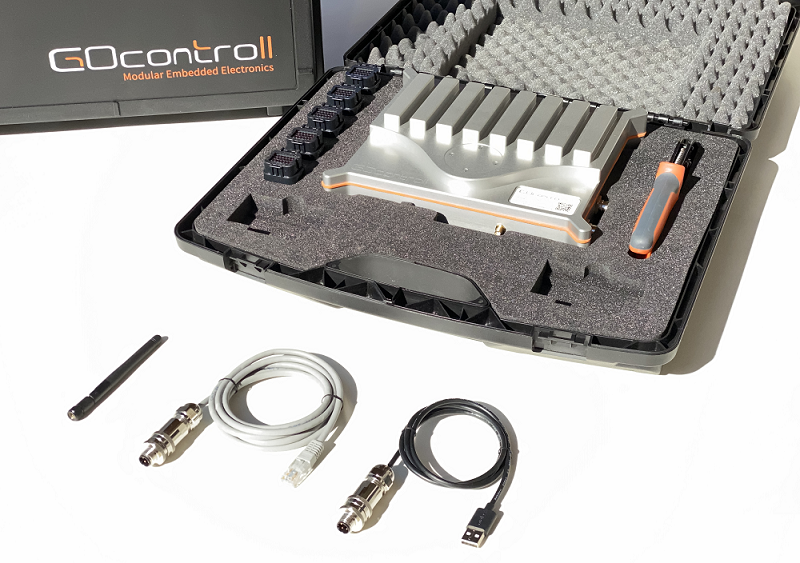
Flexibility with an Embedded Linux ECU
In today’s world, systems demand both power and adaptability. An Embedded Linux ECU offers the best of both: robust modular hardware with a flexible software layer. GOcontroll Moduline controllers run Embedded Linux, making them powerful, secure, and scalable solutions for applications across automotive, industrial, and IoT fields.
Embedded Linux ECU explained
An Embedded Linux ECU is more than just a controller. It combines the strength of modular electronics with the flexibility of Linux. GOcontroll Moduline controllers are built around powerful NXP i.MX8 processors, capable of running Debian Linux with a custom kernel and root file system.
This architecture allows:
- Easy integration of new hardware through plug-and-play IO modules.
- Standardized Linux services for networking, security, and updates.
- Flexible software development using tools like Node-RED and MATLAB Simulink.
By blending hardware and software in this way, engineers can quickly prototype, deploy, and scale their control systems.
Flexibility through modular hardware
GOcontroll’s ECU design is modular. Depending on the application, users can choose between Moduline L4, Mini I, or Display variants, each supporting different numbers of IO modules.
Advantages of modular hardware include:
- Scalability: From 2 up to 8 IO modules, depending on controller type.
- Custom configurations: Tailor the ECU to match sensor, actuator, and communication needs.
- Rugged design: Robust IP67 enclosures withstand harsh environments in automotive and industrial use.
This flexibility ensures that one ECU platform can serve multiple roles, from simple monitoring devices to complex vehicle control systems.
Linux as the software backbone
Running Linux inside an ECU brings major benefits. The Moduline controllers use Debian Linux with a carefully optimized kernel for performance and reliability.
Key Linux-based advantages:
- Service management: Control processes with systemctl for stability and debugging.
- Connectivity tools: ModemManager and NetworkManager simplify wireless and wired networking.
- Cloud-ready: Standard protocols like MQTT, HTTP, and TCP make cloud connectivity straightforward.
- Security: Continuous software updates ensure long-term protection against threats.
With these tools, developers can focus on building applications rather than reinventing infrastructure.
Cloud connectivity and remote management
One of the strongest features of an Embedded Linux ECU is its ability to connect securely to the cloud. GOcontroll controllers are designed for remote management, predictive maintenance, and secure batch software updates (FOTA).
Possible use cases include:
- Remote monitoring of vehicle or machine status.
- Predictive maintenance by analyzing real-time sensor data.
- Secure over-the-air updates to keep fleets up to date.
- Remote troubleshooting and support for reduced downtime.
- Local scripting for advanced signal correlation processing.
This makes Moduline ECUs ideal for connected systems in automotive, IoT, and industry.
Programming with Node-RED and Simulink
Instead of relying only on traditional coding, GOcontroll supports visual programming. Two popular environments are pre-installed or supported:
- Node-RED: An open-source flow-based programming tool. Perfect for building quick prototypes, cloud integrations, and communication workflows.
- MATLAB Simulink: A graphical modeling tool for advanced control algorithms. GOcontroll provides a custom blockset to integrate with hardware modules.
This combination allows both software developers and control engineers to work efficiently without needing deep embedded programming knowledge.
Future-proof and secure by design
Technology evolves quickly, but an Embedded Linux ECU is built to last. With modular hardware, flexible Linux support, and secure update strategies, GOcontroll Moduline controllers are prepared for the future.
- Expand hardware capabilities by adding new modules.
- Stay secured with Linux-based updates and patches.
- Scale from prototype to series production without hardware redesign.
This makes them a reliable foundation for next-generation embedded control solutions.
Latest blog
-

Rooftop Wind Turbine Control Node: Modular Control and Monitoring
The Moduline M1 controls rooftop wind turbines with smart load control, active yaw adjustment, vibration monitoring, and real-time remote dashboards.
-
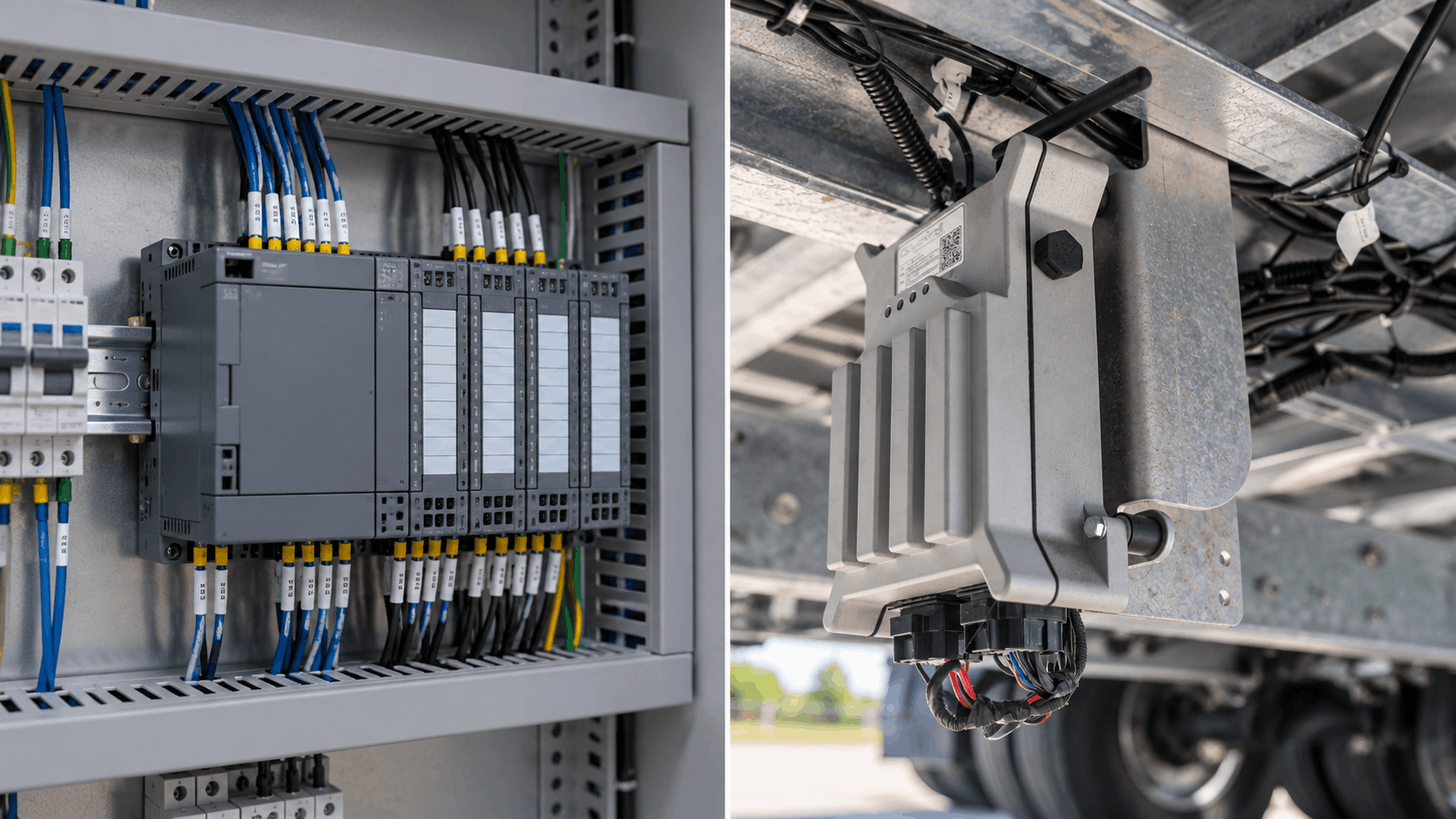
GOcontroll Moduline or a standard PLC: which controller fits your machine?
A standard PLC or GOcontroll Moduline? See how they differ in demanding environments, actuator control, flexibility and connectivity, with four applications in practice and…
-

Precise Linear Control Using Moduline
Moduline L4 linear actuator control delivers precise motion using half-bridge outputs, feedback inputs, and Simulink-based control loops.