Introduction
Heavy-duty mining trucks rely on strong hydraulic systems. The Moduline Mini I offers a rugged way to monitor these systems in real time.

Monitoring in extreme mining environments
Dump truck hydraulic system monitoring is essential in open-pit mining, where machines operate in dust, vibration and temperature extremes. These harsh conditions demand equipment that can survive long hours while still capturing accurate sensor data. The GOcontroll Moduline Mini I fits this need thanks to its robust enclosure, flexible hardware and easy-to-use software tools. With the right modules installed, it becomes a compact and reliable controller for capturing hydraulic health parameters such as pressure, temperature and pump behavior. This article explains how the controller performs in mining environments and how it supports predictive maintenance and safer operation.
Rugged hardware for hydraulic monitoring
Mining trucks create constant vibration, shock loads and dirt exposure. The Moduline Mini I is designed for field use and handles these conditions with ease. Its CNC-milled EN-AW5083 aluminium enclosure gives it high mechanical strength, while the pressure-equilibrium vent reduces condensation risk. The controller also provides IP65-equivalent protection, helping keep dust and moisture out. These features make the unit suitable for mounting close to the truck’s hydraulic components, even in hot engine bays or under mud-covered frames. The official hardware manual lists a wide operating temperature range of −20 to 85 °C, supporting reliable use during outdoor day-night shifts in the mine.
Modular IO for hydraulic sensors
Because hydraulic systems use many sensor types, flexibility is key. The Moduline Mini I supports up to four Moduline IO modules, allowing engineers to match the controller to the truck’s hydraulic configuration.
Typical module options include:
-
6-channel and 10-channel input modules for reading pressure sensors, oil temperature sensors and level switches.
-
4–20 mA input modules for industrial hydraulic transducers used in heavy equipment.
-
Output modules for controlling valves or triggering alarms.
Each module connects through automotive-grade sealed IO connectors to ensure a stable connection even under vibration. This modular structure makes it easy to adjust the setup as the hydraulic monitoring strategy evolves.
Real-time data processing on a powerful platform
Accurate dump truck hydraulic system monitoring requires fast processing. The Moduline Mini I uses an NXP i.MX8M Mini processor running at 1.6 GHz and supports Debian Linux. This gives enough computing capacity for filtering high-frequency pressure signals or running diagnostic models. Engineers can deploy their control logic using MATLAB Simulink, supported by a dedicated GOcontroll blockset. This allows them to build algorithms for pressure trend detection, thermal behavior tracking, or hydraulic pump performance without writing code.
Node-RED is also available out of the box, making it easy to create lightweight dashboards or simple data pipelines. These software tools work together to give clear insight into the health of hydraulic components.
Communication options for the mining site
Hydraulic monitoring becomes even more valuable when data can be shared with maintenance staff. The Moduline Mini I includes two CAN 2.0B interfaces, allowing easy integration with the dump truck’s existing CAN network. Through this connection, hydraulic data can be sent to vehicle displays or logged alongside engine and transmission information.
For external communication, the controller also offers Ethernet via an M12 connector. Optional features—such as Wi-Fi, Bluetooth, cellular or GNSS—can be added at assembly. These options support remote data transfer, fleet-wide reporting or on-site diagnostics through handheld devices. GOcontroll’s remote services, described in company documentation, include predictive maintenance, controller state monitoring and secure cloud access, making long-term health tracking of hydraulic systems more convenient.
Vibration and impact awareness
Mining trucks endure constant shocks from uneven terrain. The Moduline Mini I includes a built-in 3-axis accelerometer, which can capture vibration patterns. This feature helps detect abnormal events such as sudden pressure drops caused by cavitation, loose hoses or heavy impacts on hydraulic lines.
By combining sensor inputs with acceleration data, the controller supports smarter diagnostics. For example, an increase in pump noise or vibration might be linked to rising oil temperature. These relationships can be modeled in Simulink to trigger early maintenance alerts. This improves operational safety and reduces unexpected downtime in the mine.
Example workflow for hydraulic monitoring
A typical implementation for a mining dump truck may include the following steps:
Sensor collection
Pressure, temperature and filter condition sensors connect to the selected IO modules.
The Mini I reads these values continuously while filtering noise caused by vibration.
Data processing
A Simulink model evaluates pressures, temperatures and flow behavior. It calculates trends, detects spikes and identifies early failure patterns.
Event detection
When unusual conditions occur—such as rapid temperature rise or pressure collapse—the controller can generate messages via CAN or Ethernet.
Reporting and remote access
Using Node-RED or cloud connectivity options, maintenance teams can access real-time snapshots and historical logs. This creates a solid base for predictive maintenance and reduces the risk of hydraulic failure.

Moduline IV linear actuator control delivers precise motion using half-bridge outputs, feedback inputs, and Simulink-based control loops.

Moduline IV enables precise, programmable scent delivery for 5D-Cinema shows, creating reliable and immersive aroma effects.
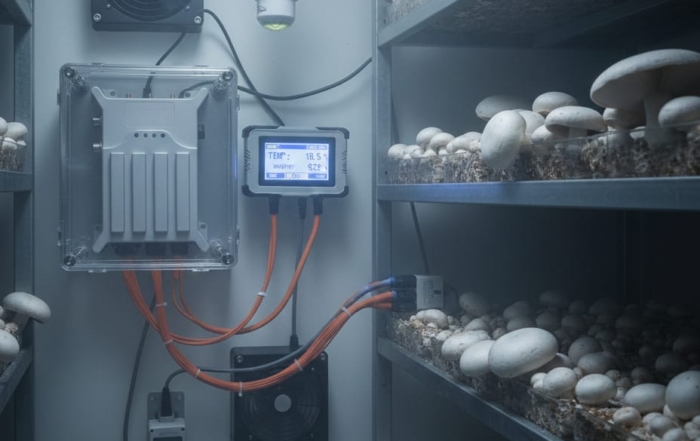
Moduline Mini I mushroom environment controller enables stable humidity, CO₂, airflow, temperature, and lighting control with Simulink and Node-RED dashboards.