Introduction
Chemical plants change fast. With the Moduline IV, engineers can adjust parameters live while keeping core logic stable and transparent.

Model-based control for evolving chemical processes
Modern chemical processes shift often—new formulations, updated setpoints, seasonal behavior, equipment wear. Yet many systems still depend on hard-coded PLC logic. When every tweak requires an external programmer, small adjustments become slow and costly.
The GOcontroll Moduline IV removes this barrier. Engineers design the control strategy in MATLAB/Simulink and deploy it directly to the controller. Meanwhile, operators adjust live parameters through a safe Node-RED dashboard. This separation between core control logic and daily tuning keeps chemical operations agile, predictable, and easy to maintain.
Why the Moduline IV fits chemical process control
The Moduline IV is a rugged, modular embedded controller built for field use, offering up to eight I/O modules, fast processing, and a Linux-based runtime.
Key reasons it suits chemical applications:
Modular I/O for diverse sensor landscapes
Chemical processes use temperature probes, flow sensors, pressure transmitters, pH probes, dosing pumps, mixers, and heaters. The Moduline IV supports:
-
Up to 80 channel input/output connectivity depending on installed modules.
-
Dedicated modules for analog, 4–20 mA, digital, and power outputs.
-
Rugged Superseal connectors and IP-rated housing for industrial environments.
With module-based expansion, the controller grows as the plant grows.
High-performance Simulink execution
The NXP i.MX8M Mini application processor (Quad Cortex-A53 @ 1.6 GHz) runs compiled Simulink models with fast boot and high reliability.
This makes it ideal for:
-
PID loops
-
Temperature control
-
Multi-stage batch logic
-
State machines
Model-based development means chemical engineers—who understand the thermodynamics and kinetics—design the control loops without writing low-level code.
Designed for industrial uptime
-
Operating temperature range −20 to 85 °C.
-
CNC-milled aluminum enclosure with pressure-equilibrium vent to resist moisture.
-
Built-in monitoring such as CPU temperature and supply voltages.
This makes the controller reliable in hot, humid, or corrosive plant areas.
Live parameter control with Node-RED
The Moduline IV comes with Node-RED preinstalled, a visual environment for dashboards, parameter panels, and data routing.
Decoupling logic and operation
A central idea for chemical plants is:
Engineers control the logic. Operators control the parameters.
The workflow looks like this:
-
Engineers build the Simulink model.
-
They expose model variables—PID gains, setpoints, timings—through GOcontroll’s Read/Write to Simulink nodes.
-
Node-RED dashboards show sliders, number inputs, graphs, or mode selectors.
-
Operators tune parameters live while the controller runs.
This prevents accidental edits to core logic while enabling day-to-day flexibility.
What can operators adjust safely?
Typical chemical process parameters include:
-
Temperature setpoints and window limits
-
Heating or cooling ramp rates
-
Mixer speeds and timing curves
-
Pump dosing durations
-
Flow correction factors
-
Filter backwash intervals
-
PID gains for critical loops
These values are stored and applied without re-deploying the Simulink model.
Seamless hardware integration
GOcontroll provides dedicated Node-RED nodes for:
-
Reading module inputs
-
Writing to outputs
-
Reading/writing Simulink signals
-
CPU temperature
-
Status LEDs
-
CAN communication
Each of these is pre-integrated, reducing the project overhead.
Example architecture for a batch-mixing chemical reactor
Below is a clean, realistic architecture workflow showing where the Moduline IV fits:
1. Sensor interfacing through I/O modules
-
6-channel input modules receive temperature, pressure, flow, and level sensors.
-
4–20 mA modules bring in industrial transmitters.
-
Output modules drive pumps, solenoids, and heating relays.
2. Simulink core logic
A Simulink model handles:
-
Multi-stage heating profiles
-
Automated mixing cycles
-
Safety constraints (overtemperature, blocked pump, low level)
-
Corrective actions
-
PID control loops
Compiled code is deployed to the Moduline IV using the upload server.
3. Node-RED operator dashboard
Operators see:
-
Live reactor temperature, pressure, flow
-
Trend graphs
-
Recipe selection
-
Gain tuning sliders
-
Manual/auto mode toggles
Data is exchanged through Read/Write Simulink nodes.
4. Remote service (optional)
GOcontroll supports cloud-based monitoring and remote updates, including:
-
Controller state monitoring
-
Batch software updates
-
Predictive maintenance
-
Secure access levels
These features help maintain distributed or unmanned systems.
How model-based design reduces engineering overhead
Chemical companies often rely on external programmers to update PLC logic. With a Moduline IV, that dependency drops dramatically because:
Engineers can express the physics directly
Simulink blocks allow domain experts to implement thermodynamic relations, mass balances, and control logic without coding. GOcontroll’s custom blockset exposes module I/O, system services, and memory mapping.
Faster iteration
When formulations or process steps change, only high-level model parameters need adjustments. The structure of the controller program remains clean and modular.
Maintainability over years
A clear separation between:
-
Model definitions
-
Parameter interfaces
-
Dashboards
-
Module configuration
…means teams can onboard new engineers without decoding complex legacy PLC code.
Safety and reliability in chemical environments
The Moduline IV supports a robust operational baseline for industrial duty:
Power and startup behavior
-
Supports 8–32 V supply.
-
Three K15 enable inputs let the plant control startup logic via Simulink.
Safety logic can read K15 levels, detect supply issues, and trigger controlled shutdowns.
Environmental and mechanical resilience
-
CNC aluminum enclosure
-
IP-rated sealing
-
Pressure-equilibrium valve
-
Vibration-resistant mounting with M5 dampeners (recommended)
These features protect electronics in chemical plant conditions.
Communication options
Depending on configuration, the Moduline IV can support:
-
Ethernet
-
CAN
-
LIN
-
Optional Wi-Fi, Bluetooth, cellular, GNSS
The diversity of communication options lets it integrate with SCADA, analyzers, and pump skids easily.
Bringing it all together: agility for chemical plants
By combining MATLAB/Simulink control with a Node-RED operational layer, the GOcontroll Moduline IV allows chemical plants to:
-
React fast to recipe changes
-
Tune parameters without external programmers
-
Maintain stable high-quality production
-
Increase transparency for auditors and technicians
-
Scale from prototype to deployment using the same platform
In short:
A chemical process becomes more agile when logic is model-based and parameters are operator-friendly.

Moduline IV linear actuator control delivers precise motion using half-bridge outputs, feedback inputs, and Simulink-based control loops.

Moduline IV enables precise, programmable scent delivery for 5D-Cinema shows, creating reliable and immersive aroma effects.
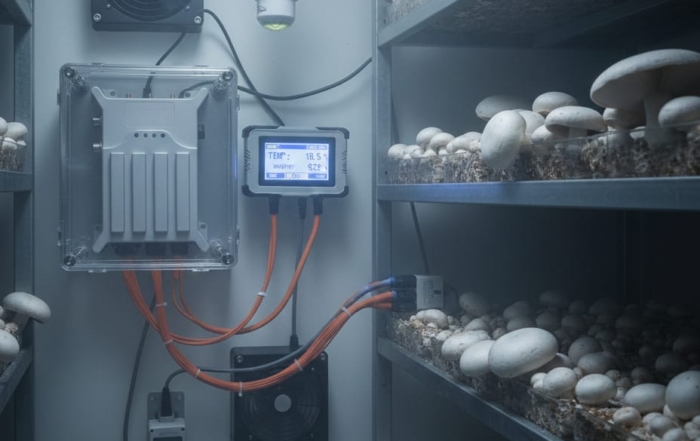
Moduline Mini I mushroom environment controller enables stable humidity, CO₂, airflow, temperature, and lighting control with Simulink and Node-RED dashboards.