
Modular Control for Maglev Trains
Published on: October 26th, 2025 · Author: Mees Meyboom
Introduction
A modular controller helps students build a stable, safe, and fully instrumented magnetic-levitation train prototype.
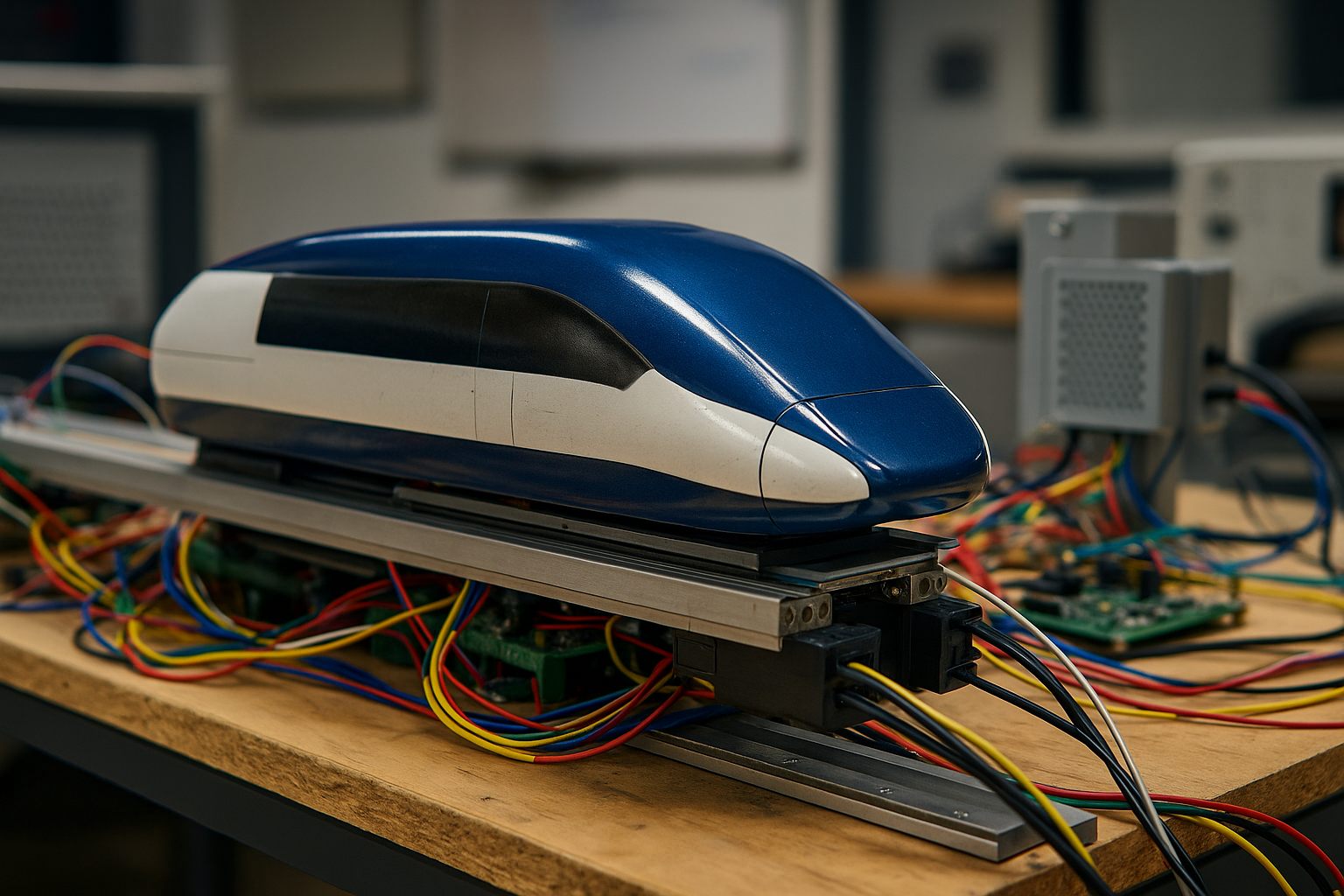
Building Stability Into Magnetic Levitation
University engineering teams often explore magnetic-levitation systems to study motion control, electromagnetics, and advanced transportation concepts. These small-scale trains float on controlled magnetic fields and move with rapid changes in force. A GOcontroll Moduline controller gives students a flexible and reliable platform for managing this complex setup. It reads sensors, drives electromagnets, and coordinates motion in real time. As a result, research teams gain a stable foundation for experiments, demonstrations, and control-system development.
A Compact Platform Built for Experimentation
Stable Levitation Through Fast Feedback
Propulsion and Braking Control
Clear Dashboards With Node-RED
Node-RED is preinstalled on GOcontroll controllers. Students can build dashboards that show:
- Coil currents
- Gap measurements
- Train position
- Temperature trends
- Power consumption
- Control-loop performance
Moreover, these dashboards help teams visualise their algorithms, compare control strategies, and record data for research papers. They also allow remote monitoring during lab demonstrations or competitions.
Simulink for Control-System Design
A Strong Base for Education and Research
Latest blog
-
Rooftop Wind Turbine Control Node: Modular Control and Monitoring
The Moduline M1 controls rooftop wind turbines with smart load control, active yaw adjustment, vibration monitoring, and real-time remote dashboards.
-
GOcontroll Moduline or a standard PLC: which controller fits your machine?
A standard PLC or GOcontroll Moduline? See how they differ in demanding environments, actuator control, flexibility and connectivity, with four applications in practice and…
-

Precise Linear Control Using Moduline
Moduline L4 linear actuator control delivers precise motion using half-bridge outputs, feedback inputs, and Simulink-based control loops.