
Rooftop Wind Turbine Control Node: Modular Control and Monitoring
Published on: October 6th, 2026 · Author: Jaap Terhaard
A rooftop wind turbine controller connects sensor measurements, operating logic and turbine hardware. For developers of small wind systems, this means bringing rotor-speed monitoring, generator-load management and equipment status together in one configurable control node.
GOcontroll Moduline M1 provides a modular platform for building this application. Its configurable I/O and programmable software let engineering teams develop a controller around their turbine, power electronics and monitoring requirements, from an initial test setup to a working installation.
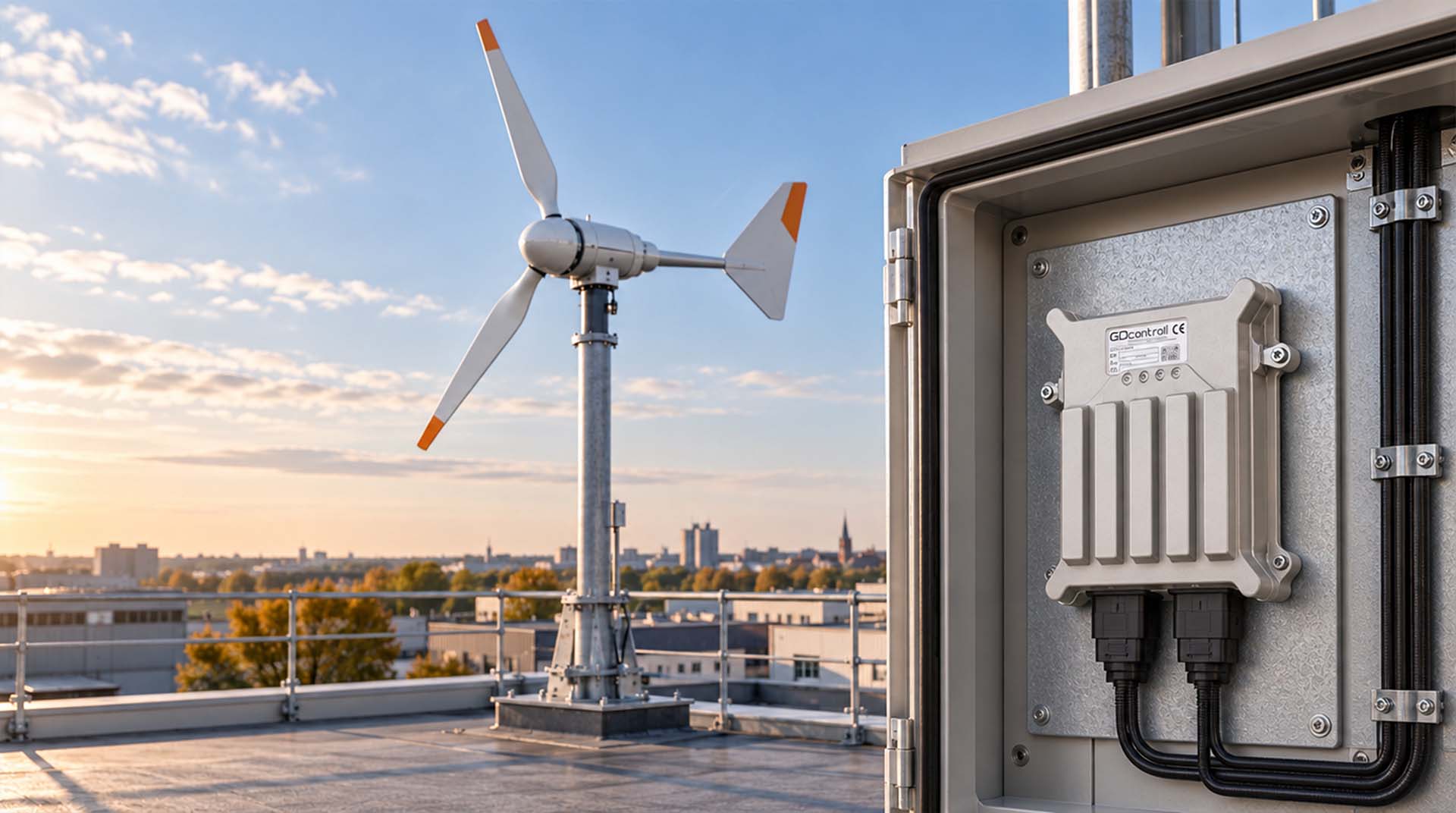
Why rooftop wind turbines need application-specific control
Wind conditions around buildings can differ substantially from those at an open site. Roof edges, neighbouring structures and obstacles create turbulent airflow. Turbines also transmit vibration through their mounting structure, which can affect the building and its occupants.
Control and measurement therefore need to work together. A system should distinguish useful operating conditions from situations that require a warning, a change of operating state or a shutdown. Recording how the turbine responds also helps developers evaluate the installation. Good control supports this process; it cannot compensate for an unsuitable wind resource or mounting design.
What does a rooftop wind turbine controller do?
The control node turns measured signals into actions and usable information. Its role depends on the turbine architecture: some systems need only monitoring and supervisory commands, while others also require actuator control. The following signals are examples of what an application can combine.
| Measurement or status | Purpose in the control application |
| Rotor speed | Compare operating speed with the turbine’s configured limits. |
| Generator voltage and current | Assess electrical operating conditions and calculate power at the measurement point. |
| Wind speed and direction | Record local conditions and support orientation logic where applicable. |
| Yaw position and limit switches | Check orientation and permitted travel on an actively oriented turbine. |
| Vibration and temperature | Track equipment condition and identify changes for investigation. |
| Converter or brake status | Confirm that commanded operating states match equipment feedback. |
Modular hardware for turbine sensors and actuators
The Moduline M1 runs Linux on an NXP i.MX8M Mini processor and provides four slots for compatible modules. It includes two CAN 2.0B interfaces, Ethernet and USB. This allows the controller to combine local I/O with communication to compatible external equipment.
The installed modules determine the signals the controller can read and the outputs it can drive. An illustrative configuration could combine:
A 6 Channel Input Module for analog voltages, switches, rotor-speed signals or encoder feedback.
A 4–20 mA Input Module for compatible industrial transmitters, with wire-break diagnostics.
A 6 Channel Output Module for suitable relays, valves and other low-voltage actuators.
A 2 Channel Power Bridge Module for a compatible bidirectional DC motor or actuator.
The 6 Channel Input Module supports selectable 0–5 V, 0–12 V and 0–24 V ranges, as well as frequency and encoder measurements. Generator measurements must therefore use transducers and signal conditioning appropriate to the actual voltage, current and isolation requirements.
Output selection is equally important. The 6 Channel Output Module supports high-side, low-side, half-bridge and PWM modes; the Power Bridge Module offers a full-bridge arrangement by combining its two channels. Check supply voltage, actuator current, starting current and thermal limits against the selected module. Generator power, inverter power and large dump loads require a suitably rated power stage.
Generator-load control and MPPT integration
Electrical loading influences the torque opposing the rotor’s motion. In a variable-speed turbine, the control strategy can use generator torque or converter setpoints to influence the operating point. Maximum power point tracking, or MPPT, aims to select an operating point that captures useful power as conditions change.
In a compatible system, Moduline can provide supervisory logic, collect measurements and send commands to external power electronics. The division of responsibilities must be defined: a converter may execute its own fast electrical control loops while the control node manages operating states and setpoints.
Some small wind systems use a diversion or dump load to absorb energy when the normal destination cannot accept it. Its switching hardware and resistor bank must be matched to the system. Simply reducing electrical load does not necessarily slow a turbine; it can reduce generator braking torque and allow rotor speed to rise. Overspeed responses must follow the turbine’s validated braking and shutdown strategy.
Yaw control for turbines with active orientation
Yaw control turns a turbine towards the wind. It is relevant to horizontal-axis designs with a powered orientation mechanism. Many small turbines align passively, while vertical-axis turbines generally do not need yaw alignment.
For an actively oriented design, an application could combine wind-direction measurements, position feedback and limit switches to command a compatible drive. Filtering, an angular deadband and a minimum time between movements can help avoid repeated corrections in fluctuating wind. These settings, along with travel limits and cable management, are engineering choices to validate on the actual mechanism.
Vibration monitoring for turbine condition assessment
Vibration data becomes more useful when it is considered alongside rotor speed and operating state. A change at comparable speeds may justify inspecting the rotor, bearings or mounting. The measurements support diagnosis; a single threshold does not identify every fault.
A compatible 4–20 mA vibration transmitter can provide an overall indicator, such as RMS vibration velocity, for trending and alarms. This is different from acquiring the raw accelerometer waveform for frequency analysis. Detailed diagnostics require suitable sensors, acquisition bandwidth and analysis hardware or software.
The application can record an event, notify an operator or request a defined change of state when a limit is exceeded. Warning levels and protective actions should reflect the turbine and structure rather than a generic vibration threshold.
Develop control logic with MATLAB/Simulink and Node-RED
MATLAB/Simulink can be used to develop the application’s control model. For a turbine project, an illustrative state sequence might include standby, startup, normal operation, controlled stopping and fault handling. Each transition can depend on measured conditions and feedback from connected equipment.
GOcontroll provides a way for Node-RED to read exposed signals and write exposed parameters in a running Simulink application. This lets a team build an operational interface around the control model. Parameter ranges, permissions and timing requirements still need to be defined for the application. A dashboard refresh interval should not be confused with the execution rate of a control loop.
Remote wind turbine monitoring and data logging
Node-RED is installed on Moduline M1 and can be configured for data logging and operational interfaces. A turbine dashboard could show rotor speed, electrical power, operating state, vibration indicators and active faults. Timestamped CSV logs can help teams compare test runs and examine the events leading up to a shutdown.
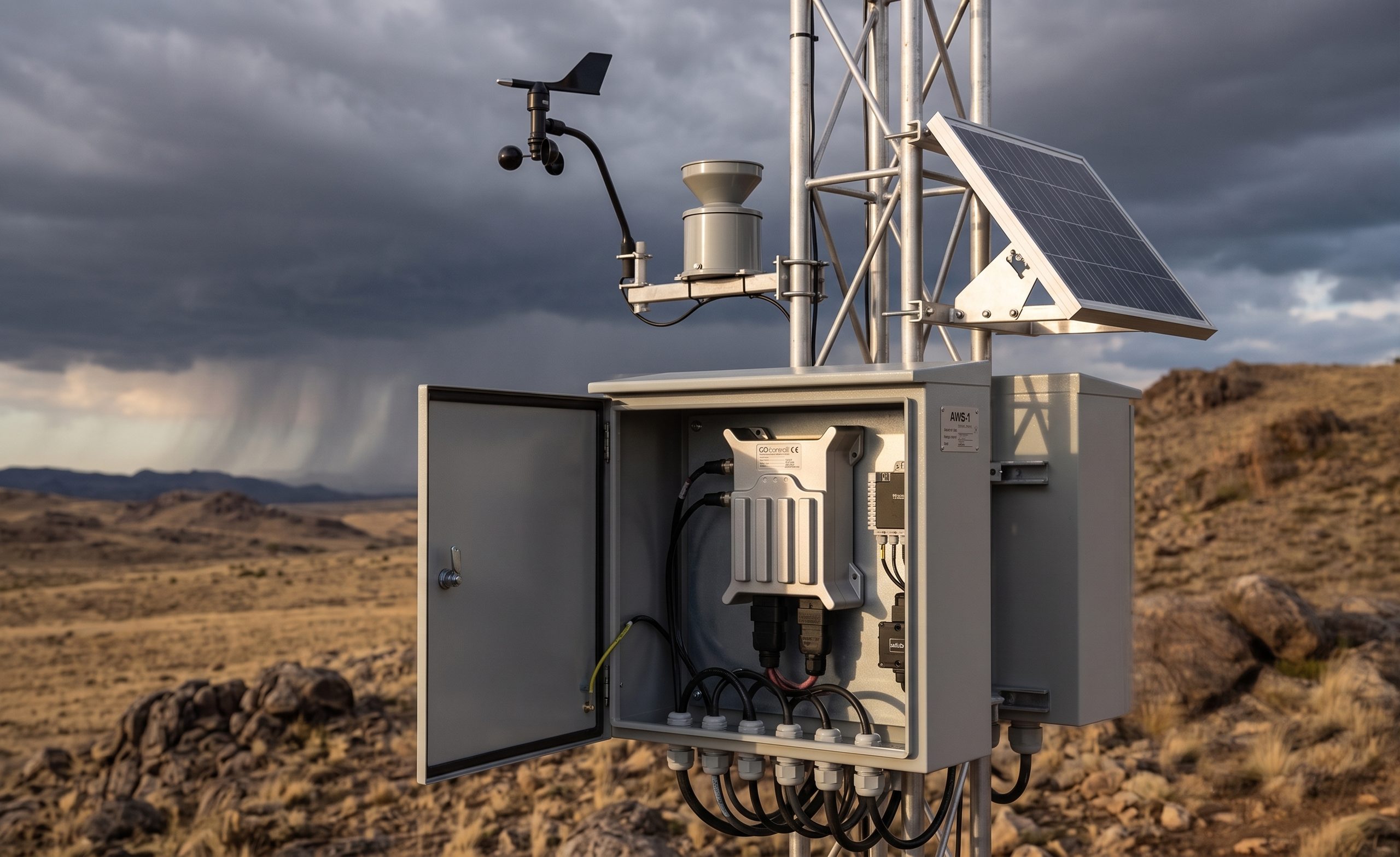
Through MQTT or HTTP, selected data can also be exchanged with an external monitoring service. Network access, authentication and the remote interface must be configured for the installation. Local logging needs a retention policy so stored measurements do not exhaust the controller’s available space.
This creates a useful separation of roles: turbine operation takes place locally, while a connected service makes status and history available to installers, researchers or building managers. The control design should define what happens if that connection is lost.
From a rooftop prototype to a connected energy installation
A development project can begin with a focused set of measurements and add compatible modules as requirements change, within the M1’s four-slot capacity. The same approach can support different turbine variants without assuming that every version needs the same I/O configuration.
Where equipment exposes compatible interfaces and protocols, the node can exchange status or commands with a battery system, inverter or wider energy-management system. Moduline provides the programmable control layer; the power conversion, energy storage and turbine protection remain parts of the complete system design.
FAQ about rooftop wind turbine control
Can Moduline replace a wind turbine inverter?
It provides the control and I/O layer. A turbine still needs power electronics matched to its generator and energy destination. The controller can coordinate compatible equipment, but does not replace the inverter’s power-conversion function.
Can the controller read different types of turbine sensors?
Yes, with appropriate modules and signal conditioning. Supported options include digital, analog-voltage, frequency, encoder and 4–20 mA signals. Sensor ranges and electrical requirements determine the configuration.
Does every rooftop wind turbine need yaw control?
No. Active yaw control applies to designs with a powered orientation mechanism. Passive alignment and vertical-axis designs have different requirements.
Can turbine data be monitored remotely?
Yes. A configured Node-RED application can exchange data with a remote service using protocols such as MQTT or HTTP. The installation needs suitable connectivity and access control.
Let’s find the right technical match for your wind turbine
Developing a small wind turbine, research setup or rooftop control system? Start with the functions your application needs: what to measure, what to drive and which equipment needs to communicate.
In a Technical Fit Check, GOcontroll explores your signals, actuator requirements, operating environment and development plans with you. Together, we can identify a suitable controller and module configuration for your application.
Discuss your wind turbine control application with GOcontroll.
Latest blog
-
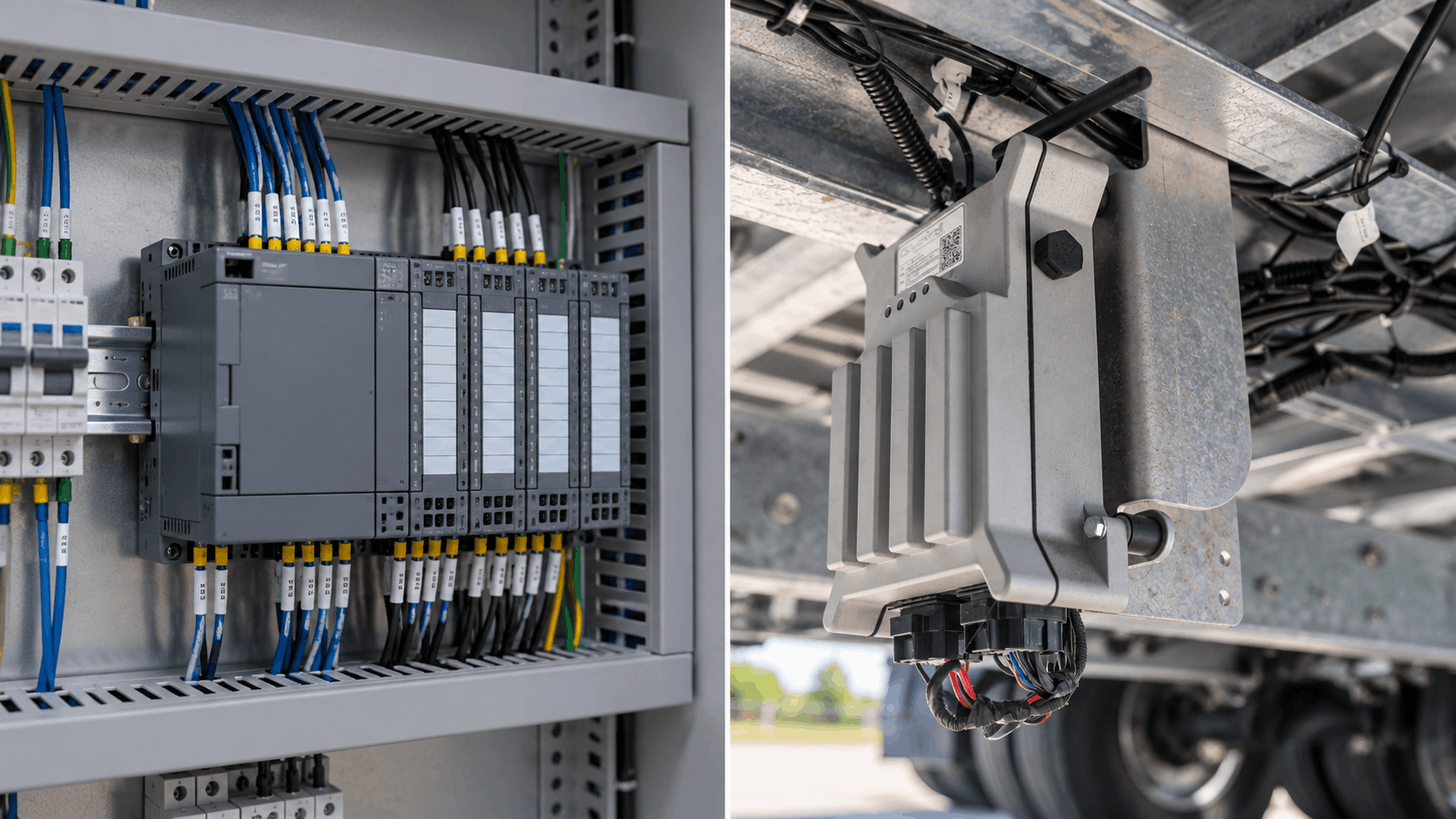
GOcontroll Moduline or a standard PLC: which controller fits your machine?
A standard PLC or GOcontroll Moduline? See how they differ in demanding environments, actuator control, flexibility and connectivity, with four applications in practice and…
-

Precise Linear Control Using Moduline
Moduline L4 linear actuator control delivers precise motion using half-bridge outputs, feedback inputs, and Simulink-based control loops.
-
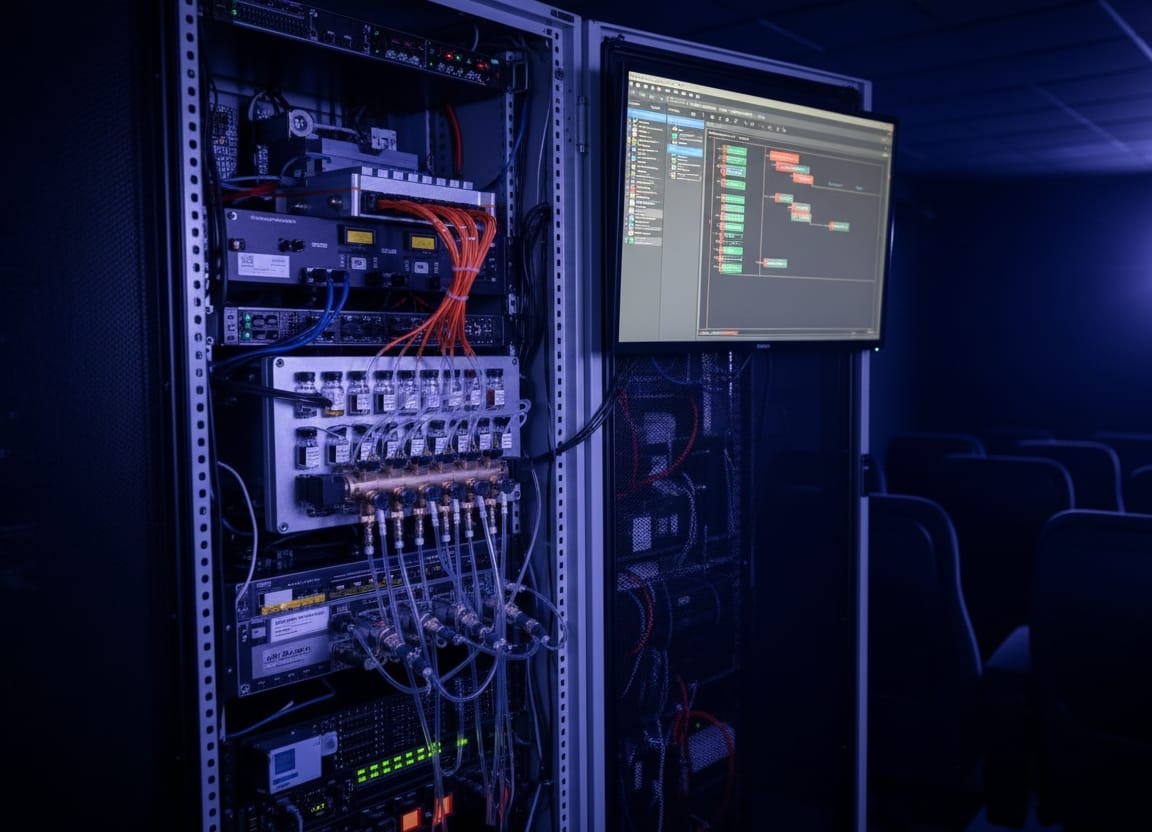
Moduline L4 5D-Cinema Scent Automation
Moduline L4 enables precise, programmable scent delivery for 5D-Cinema shows, creating reliable and immersive aroma effects.