

Programmable Vehicle Controllers for Special Vehicles
GOcontroll provides modular, programmable vehicle controllers for custom-built vehicles, specialist vehicles and low-volume production. Combine CAN bus communication, configurable I/O, vehicle body control and digital driver interfaces in a flexible control platform that adapts to your vehicle concept.
Control that moves with your vehicle concept.
Special vehicles rarely call for a standard solution. You combine unique functions, limited production runs, different components and a design that keeps evolving. GOcontroll brings I/O, CAN communication, HMI and control logic together in one freely programmable platform.
From prototype development to production, GOcontroll helps vehicle builders integrate custom functions and evolve their control systems without starting from scratch.
What GOcontroll solves for special vehicles.
Control vehicle functions
From lighting, heating and wipers to hydraulics, drivetrains and customer-specific functions.
Create a clear driver interface
With an HMI, digital instrument cluster or infotainment display that fits the user and the vehicle.
Connect components intelligently
Through CAN, I/O and gateways between sensors, actuators, displays, battery systems and drivetrains.
Add monitoring and connected service
Collect data, track component condition and make maintenance more predictable.

Flexible Control for Low-Volume Vehicle Development
A vehicle design does not stand still. With the Moduline product family, you can test functions, adapt software and add I/O or communication later. The hardware is modular and the software is freely programmable. A change in your vehicle concept does not have to mean starting over with a new control system.
CAN Bus Vehicle Controllers with Modular I/O
Modern special vehicles combine electronic systems that need to exchange information. GOcontroll Moduline controllers use CAN bus to communicate with compatible vehicle systems, sensors, actuators and driver interfaces. Integration depends on the protocols, message definitions and application software in your vehicle.
The Moduline M1 includes two CAN 2.0B interfaces and four module slots. The Moduline L4 offers four CAN 2.0B interfaces and eight module slots. Select compatible input and output modules to match your signals and electrical loads.
Programmable Vehicle Body Control Modules
A programmable vehicle body control module translates signals from switches and sensors into control logic for comfort and auxiliary functions. Heating, blowers, seat heating and windscreen wipers are examples from The Landrovers. Check the required voltage, current, protection and output type for each load before choosing the I/O modules.
Custom Digital Instrument Clusters and Driver Interfaces
For digital dashboards and custom driver interfaces, the Moduline HMI1 combines a 10.1-inch touchscreen with a programmable control platform, two I/O module slots and two CAN interfaces supporting CAN 2.0B and CAN FD. Screen layouts and HMI software can be tailored to your application. Display hardware and vehicle signal integration are selected for each project.
Choose M1, L4 or HMI1 for Your Special Vehicle
Moduline M1: a Linux-based controller with four I/O module slots and two CAN 2.0B interfaces for configurable vehicle body functions and custom controls. Explore the M1 specifications.
Moduline L4: a Linux-based controller with eight I/O module slots, four CAN 2.0B interfaces and one LIN interface for architectures with more signals and connections. Explore the L4 specifications.
Moduline HMI1: a touchscreen controller with two I/O module slots for driver information, diagnostics and interaction. Explore the HMI1 specifications.
The right configuration depends on I/O types, electrical loads, communication protocols, mounting conditions and software architecture. Request a Technical Fit Check to assess your vehicle requirements, or explore configurations if you already know the hardware you need.
For background, read how an electronic control unit works and the introduction to the Moduline product family.
Proven in the real world.

The Landrovers: vehicle body control and digital instruments.
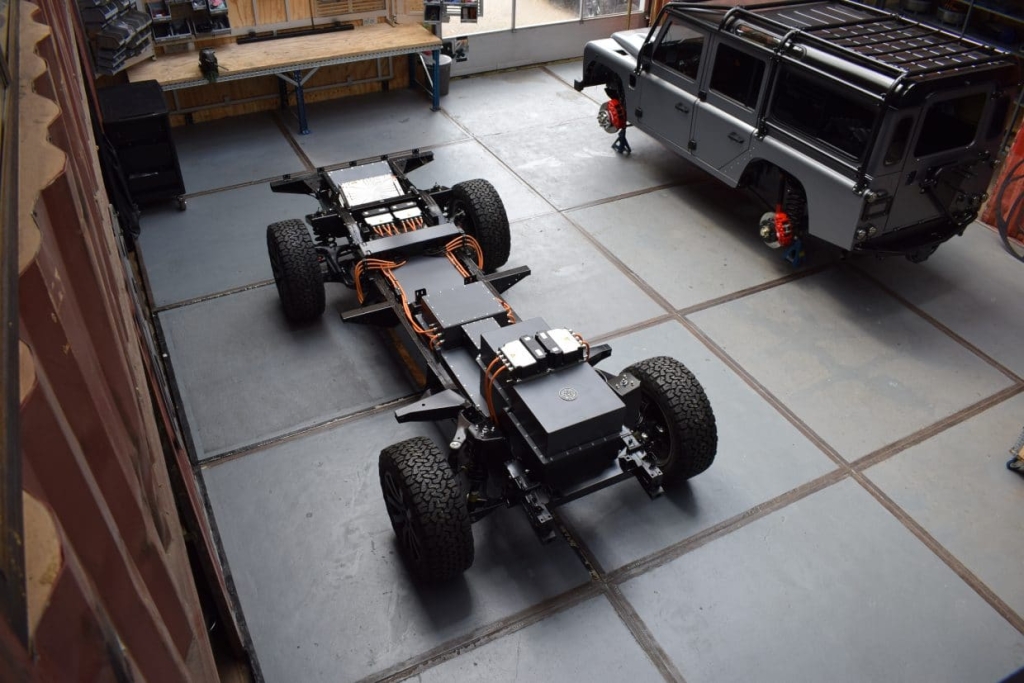
The Landrovers builds fully custom V8 and electric Land Rover Defenders. For these distinctive vehicles, GOcontroll supplies an HMI for the digital instrument cluster and infotainment. It brings vehicle information, operation and a modern user experience together in a solution that fits every unique vehicle.
The Moduline M1 operates as a body control module for heating, the blower, seat heating and windscreen wipers. The Moduline L4 has also been used during development of the electric Defender programme. The collaboration shows what a flexible platform delivers: functions can be tested during development, screen layouts can be tailored to the vehicle, and the electronics can evolve when specifications change.

Kraker Trailers: connected trailer control with Moduline M1.
At Kraker Trailers, Moduline M1 is used as a powerful, compact basis for trailer control. The application supports sensors, driver operation, vehicle data and connected service. This creates a trailer that not only performs its job, but also delivers data for smarter maintenance and better availability.
GOcontroll supports this with controller hardware, system architecture, software and the driver interface. In the Smart Trailer project, a custom sensor measures moving-floor wear and a Moduline M1 with 4G/LTE connects the data to cloud monitoring. GOcontroll also supplied the M1 and supported software and driver-interface development for the E-Trailer.
Frequently Asked Questions about Vehicle Controllers
What is a programmable vehicle controller?
A programmable vehicle controller is an electronic control unit (ECU) that processes input signals, runs application-specific control logic and drives compatible outputs or exchanges data with other vehicle electronics. GOcontroll Moduline controllers offer modular I/O and configurable software for specialist vehicles and custom builds.
Can GOcontroll controllers communicate with vehicle systems via CAN bus?
Yes. The Moduline M1 has two CAN 2.0B interfaces and the Moduline L4 has four. The Moduline HMI1 offers two CAN interfaces supporting CAN 2.0B and CAN FD. Communication with a particular vehicle ECU or protocol must be validated for the software and network configuration.
Can the Moduline M1 be used as a vehicle body control module?
Yes. The Landrovers uses a Moduline M1 for heating, blower operation, seat heating and windscreen wipers in customised Land Rover Defenders. Other functions depend on the selected I/O modules, electrical loads and control software.
Can GOcontroll support a custom digital dashboard or instrument cluster?
Yes. The Moduline HMI1 combines a 10.1-inch touchscreen, programmable control and modular I/O. GOcontroll has supported The Landrovers with digital instrument clusters, infotainment displays and custom display hardware. Each new project requires its own interface and signal-integration design.
Which GOcontroll controller is suitable for a low-volume or custom-built vehicle?
Choose according to your I/O count and types, electrical loads, vehicle networks, display requirements and software needs. The M1 offers four expansion slots, the L4 eight, and the HMI1 combines two slots with a touchscreen. A Technical Fit Check can help evaluate the configuration.
Can I adapt the control system during vehicle development?
Yes. With the Moduline platform, engineers can change application software and add or exchange compatible I/O modules within the available slots. This is useful when prototype requirements change or variants need different signals and functions.
Are GOcontroll controllers certified for safety-critical vehicle functions?
Do not assume functional-safety certification or suitability for any particular safety-critical function. Assess the intended application, applicable regulations and required safety integrity. Where necessary, design with a separately validated safety controller and additional protective measures. Vehicle approval and environmental requirements must also be assessed for the specific installation.
Let’s find the right technical fit.
Building a custom vehicle or planning a low-volume series? Tell us what you want to control. In a Technical Fit Check, we explore your functions, signals, electrical loads, driver-interface needs and scalability. Share an I/O list or system sketch if you have one.